 | Weekly Space Hangout: 11-JAN-2023: The Final Episode
Join us this week for our first News Roundup of the New Year, which is also the final episode of the Weekly Space Hangout! Thank you to everyone who made this show possible over the years and who helped bring science to the community!
****************************************
The Weekly Space Hangout is a production of CosmoQuest. Want to support CosmoQuest? Here are some specific ways you can help:
► Subscribe FREE to our YouTube channel at
https://www.youtube.com/c/cosmoquest
► Subscribe to our podcasts Astronomy Cast and Daily Space where ever you get your podcasts!
► Watch our streams over on Twitch at
https://www.twitch.tv/cosmoquestx – follow and subscribe!
► Become a Patreon of CosmoQuest
https://www.patreon.com/cosmoquestx
► Become a Patreon of Astronomy Cast
https://www.patreon.com/astronomycast
► Buy stuff from our Redbubble
https://www.redbubble.com/people/cosmoquestx
► Join our Discord server for CosmoQuest -
https://discord.gg/pVGXJDUKud
► Join the Weekly Space Hangout Crew! -
http://www.wshcrew.space/
Don't forget to like and subscribe! Plus we love being shared out to new people, so tweet, comment, review us… all the free things you can do to help bring science into people's lives. Source: © Weekly Space Hangout, hosted on © YouTube |
 | Weekly Space Hangout: 04-JAN-2023: Dr. Eddie Schwieterman Discusses Nitrous Oxide as a Biosignature
Historically, scientists using spectrographic analysis to study exoplanet atmospheres have considered oxygen and methane as two key biosignatures when identifying "life-friendly" planets. But could nitrous oxide (N2O) — aka "Laughing Gas" — also be a reliable biosignature? A recent paper published in the October, 2022, Astrophysical Journal (
https://iopscience.iop.org/article/10.3847/1538-4357/ac8cfb) explains why N2O can — and should — be included as a biosignature gas. Tonight we are pleased to welcome the paper's lead author, Dr. Eddie Schwieterman, astrobiologist at UC Riverside, to discuss why N2O is an indicator of life.
Dr. Eddie Schwieterman is an Assistant Professor of Astrobiology in the Department of Earth and Planetary Sciences at the University of California, Riverside. He earned his undergraduate degrees in physics and astrophysics from the Florida Institute of Technology and his PhD in astronomy and astrobiology from the University of Washington in Seattle.
Dr. Schwieterman studies the climate, atmospheric chemistry, geochemical evolution, and spectral appearance of terrestrial (rocky) planets. His research specifically focuses on the habitability and potential biosignatures of exoplanets.
To learn more about Eddie's research visit his website (www.eddieschwieterman.com) and follow him on Twitter: @nogreenstars (
https://twitter.com/nogreenstars)
You can also read more about nitrous oxide as biosignature in the following SciNews article: Nitrous Oxide Could Help Detect Extraterrestrial Life on Exo-Earths (
https://www.sci.news/astronomy/biosignature-nitrous-oxide-11260.html)
****************************************
The Weekly Space Hangout is a production of CosmoQuest. Want to support CosmoQuest? Here are some specific ways you can help:
► Subscribe FREE to our YouTube channel at
https://www.youtube.com/c/cosmoquest
► Subscribe to our podcasts Astronomy Cast and Daily Space where ever you get your podcasts!
► Watch our streams over on Twitch at
https://www.twitch.tv/cosmoquestx – follow and subscribe!
► Become a Patreon of CosmoQuest
https://www.patreon.com/cosmoquestx
► Become a Patreon of Astronomy Cast
https://www.patreon.com/astronomycast
► Buy stuff from our Redbubble
https://www.redbubble.com/people/cosmoquestx
► Join our Discord server for CosmoQuest -
https://discord.gg/pVGXJDUKud
► Join the Weekly Space Hangout Crew! -
http://www.wshcrew.space/
Don't forget to like and subscribe! Plus we love being shared out to new people, so tweet, comment, review us… all the free things you can do to help bring science into people's lives. Source: © Weekly Space Hangout, hosted on © YouTube |
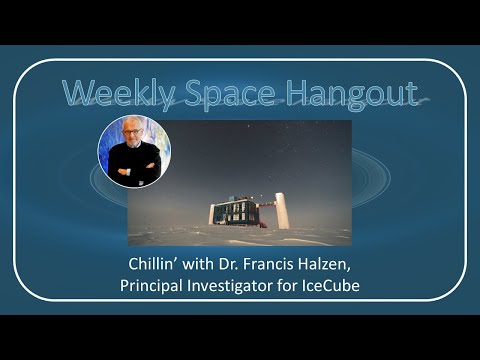 | Weekly Space Hangout: 14-DEC-2022: Chillin' with Dr. Francis Halzen, PI of IceCube
Viewers who watched our November 16, 2022, episode may remember that Dr. Leah Jenks told us about high-energy neutrino emissions from NGC 1068 that were detected by IceCube. (
https://icecube.wisc.edu/news/press-releases/2022/11/icecube-neutrinos-give-us-first-glimpse-into-the-inner-depths-of-an-active-galaxy/) This week we are pleased to welcome Dr. Francis Halzen, Principal Investigator for IceCube, who will discuss the significance of these detections in understanding how active galaxies "work," and potentially ushering in the age of Neutrino Astronomy.
With funding from the National Science Foundation the IceCube project at the South Pole melted eighty-six holes over 1.5 miles deep in the Antarctic icecap to construct an enormous astronomical observatory. The experiment discovered a flux of neutrinos reaching us from the cosmos, with energies more than a million times those of neutrinos produced at accelerator laboratories. These cosmic neutrinos are astronomical messengers coming from some of the most violent processes in the universe and from the biggest explosions since the Big Bang. We will discuss the IceCube telescope and highlight the recent discoveries that some high-energy neutrinos—and cosmic rays—originate from sources powered by rotating supermassive black holes.
Francis Halzen is a Vilas and Gregory Breit Distinguished Professor of Physics at the University of Wisconsin–Madison.
Born in Belgium, Halzen received his Master’s and PhD degrees from the KUL Leuven, Belgium, and has been on the physics faculty at UW–Madison since 1972; in 2021, Halzen was named a Vilas Research Professor, one of the university’s most prestigious honors. He has been a fellow of the American Physical Society since 1994, and is the recipient of numerous awards, including the 2014 "Smithsonian" American Ingenuity Award (
https://icecube.wisc.edu/news/awards/2014/10/uw-physicist-francis-halzen-receives-american-ingenuity-award/), the 2015 Balzan Prize (
https://icecube.wisc.edu/news/awards/2015/09/francis-halzen-wins-2015-balzan-prize/), a 2018 Bruno Pontecorvo Prize, the 2019 IUPAP Yodh Prize (
https://icecube.wisc.edu/news/awards/2019/08/francis-halzen-awarded-2019-yodh-prize/), the 2021 Bruno Rossi Prize of the American Astronomical Society (
https://icecube.wisc.edu/news/awards/2021/01/icecube-collaboration-awarded-2021-rossi-prize/), the 2021 Homi Bhabha Award (
https://icecube.wisc.edu/news/awards/2021/07/2021-homi-bhabha-award-given-to-francis-halzen-icecube-pi/), and honorary doctorates at several universities.
Halzen is the Principal Investigator of IceCube, a cubic-kilometer neutrino telescope buried in the Antarctic ice at the South Pole. IceCube’s first observations of high-energy cosmic neutrinos garnered the 2013 "Physics World" Breakthrough of the Year Award. In September 2017, IceCube detected a high-energy neutrino from the direction of a blazar called TXS 0506+056. This was the first-ever evidence of a source of high-energy cosmic rays, whose origins have been notoriously difficult to pinpoint since they were discovered over one hundred years ago.
Also a skilled science communicator, Halzen travels widely, giving about 20 or more invited talks per year at conferences, workshops, and colloquia. He also gives regular public talks to local and national groups and interviews for television and radio. Halzen is the co-author of "Quarks and Leptons", a classic textbook on modern particle physics that continues to be used extensively throughout college campuses today. He has a large number of publications to his credit and has written or edited several other books. His essay “Antarctic Dreams,” about the early days of AMANDA, IceCube’s precursor, was featured in "The Best American Science Writing 2000".
To stay up-to-date with IceCube, visit the IceCube website:
https://icecube.wisc.edu/ and follow them on Twitter (@uw_icecube), Instagram (@icecube_neutrino), and Facebook (@icecubeneutrino).
Image credit: Martin Wolf, IceCube/NSF
****************************************
The Weekly Space Hangout is a production of CosmoQuest. Want to support CosmoQuest? Here are some specific ways you can help:
► Subscribe FREE to our YouTube channel at
https://www.youtube.com/c/cosmoquest
► Subscribe to our podcasts Astronomy Cast and Daily Space where ever you get your podcasts!
► Watch our streams over on Twitch at
https://www.twitch.tv/cosmoquestx – follow and subscribe!
► Become a Patreon of CosmoQuest
https://www.patreon.com/cosmoquestx
► Become a Patreon of Astronomy Cast
https://www.patreon.com/astronomycast
► Buy stuff from our Redbubble
https://www.redbubble.com/people/cosmoquestx
► Join our Discord server for CosmoQuest -
https://discord.gg/pVGXJDUKud
► Join the Weekly Space Hangout Crew! -
http://www.wshcrew.space/
Don't forget to like and subscribe! Plus we love being shared out to new people, so tweet, comment, review us… all the free things you can do to help bring science into people's lives. Source: © Weekly Space Hangout, hosted on © YouTube |
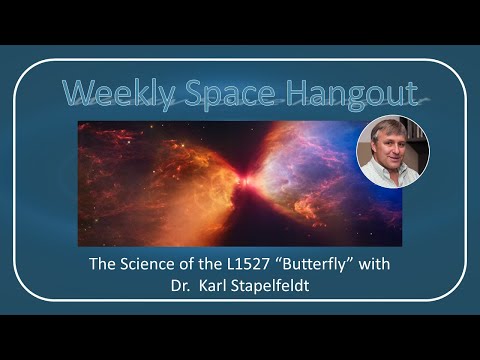 | Weekly Space Hangout: 07-DEC-2022: The Science of the L1527 "Butterfly" with Dr. Karl Stapelfeldt
During our November 16th show, Carolyn Collins Petersen introduced us to the hourglass/butterfly of L1527, an image captured by JWST using its onboard NIRCam. (You can read the original story here:
https://www.nasa.gov/feature/goddard/2022/nasa-s-webb-catches-fiery-hourglass-as-new-star-forms) This week we are joined by Dr. Karl Stapelfeldt, Chief Scientist for NASA's Exoplanet Exploration Program at JPL who will help us understand the science behind this amazing structure.
Karl earned a B.S.E. in Aerospace Engineering and Engineering Physics at Princeton University, and a Ph.D. in Astrophysics at Caltech. His career at NASA includes positions at both the Jet Propulsion Laboratory and most recently at the Goddard Space Flight Center, where he has served as the Chief of Goddard's Exoplanets and Stellar Astrophysics Laboratory since 2011.
Karl’s NASA science contributions include project science roles for the Hubble and Spitzer Space Telescopes and science observations using the Herschel Space Observatory. He served as chair of the Exoplanet-Coronagraph Probe-Scale Science and Technology Definition Team, and as a member of the Astrophysics Subcommittee of the NASA Advisory Council.
****************************************
The Weekly Space Hangout is a production of CosmoQuest. Want to support CosmoQuest? Here are some specific ways you can help:
► Subscribe FREE to our YouTube channel at
https://www.youtube.com/c/cosmoquest
► Subscribe to our podcasts Astronomy Cast and Daily Space where ever you get your podcasts!
► Watch our streams over on Twitch at
https://www.twitch.tv/cosmoquestx – follow and subscribe!
► Become a Patreon of CosmoQuest
https://www.patreon.com/cosmoquestx
► Become a Patreon of Astronomy Cast
https://www.patreon.com/astronomycast
► Buy stuff from our Redbubble
https://www.redbubble.com/people/cosmoquestx
► Join our Discord server for CosmoQuest -
https://discord.gg/pVGXJDUKud
► Join the Weekly Space Hangout Crew! -
http://www.wshcrew.space/
Don't forget to like and subscribe! Plus we love being shared out to new people, so tweet, comment, review us… all the free things you can do to help bring science into people's lives. Source: © Weekly Space Hangout, hosted on © YouTube |
 | Weekly Space Hangout: 30-NOV-2022: Another News Roundup!
It's time for another News Roundup ! Buckle up for another hour of news!!
****************************************
The Weekly Space Hangout is a production of CosmoQuest. Want to support CosmoQuest? Here are some specific ways you can help:
► Subscribe FREE to our YouTube channel at
https://www.youtube.com/c/cosmoquest
► Subscribe to our podcasts Astronomy Cast and Daily Space where ever you get your podcasts!
► Watch our streams over on Twitch at
https://www.twitch.tv/cosmoquestx – follow and subscribe!
► Become a Patreon of CosmoQuest
https://www.patreon.com/cosmoquestx
► Become a Patreon of Astronomy Cast
https://www.patreon.com/astronomycast
► Buy stuff from our Redbubble
https://www.redbubble.com/people/cosmoquestx
► Join our Discord server for CosmoQuest -
https://discord.gg/pVGXJDUKud
► Join the Weekly Space Hangout Crew! -
http://www.wshcrew.space/
Don't forget to like and subscribe! Plus we love being shared out to new people, so tweet, comment, review us… all the free things you can do to help bring science into people's lives. Source: © Weekly Space Hangout, hosted on © YouTube |
 | Weekly Space Hangout: October 21, 2020, Dr. Jill Tarter and the Search for Technosignatures
This week we are excited (and honored) to welcome Dr. Jill Tarter to the Weekly Space Hangout. Best known for her work in the field of SETI, tonight Jill will be discussing the search for technosignatures.
Dr. Jill Tarter is the Emeritus Chair for SETI Research at the SETI Institute in Mountain View, California and serves as a member of the Board of Trustees for that institution.
Tarter received her Bachelor of Engineering Physics Degree with Distinction from Cornell University and her Master’s Degree and a Ph.D. in Astronomy from the University of California, Berkeley. She has spent the majority of her professional career attempting to answer the old human question “Are we alone?” by searching for evidence of technological civilizations beyond Earth.
She served as Project Scientist for NASA’s SETI program, the High Resolution Microwave Survey and has conducted numerous observational programs at radio observatories worldwide. She is a Fellow of the AAAS, the California Academy of Sciences, and the Explorers Club, she was named one of the Time 100 Most Influential People in the World in 2004, and one of the Time 25 in Space in 2012, received a TED prize in 2009, two public service awards from NASA, multiple awards for communicating science to the public, and has been honored as a woman in technology. She was the 2014 Jansky Lecturer, and received a Genius Award from Liberty Science Center in 2015. She served as President of the California Academy of Sciences 2015-16. Asteroid 74824 Tarter (1999 TJ16) has been named in her honor.
Since the termination of funding for NASA’s SETI program in 1993, she has served in a leadership role to design and build the Allen Telescope Array and to secure private funding to continue the exploratory science of SETI.
Many people are now familiar with her work as portrayed by Jodie Foster in the movie Contact. Her biography Making Contact was written by Sarah Scoles and published in 2017.
You can read an excerpt from Jill's biography Making Contact and learn how to get your own copy here:
https://books.google.com/books/about/Making_Contact_Jill_Tarter_and_the_Searc.html?id=HTIpDwAAQBAJ&printsec=frontcover&source=kp_read_button#v=onepage&q&f=false
You can learn more about Jill by visiting her SETI profile here:
https://www.seti.org/our-scientists/jill-tarter
To learn more about the Allen Telescope Array, visit
https://www.seti.org/ata
****************************************
The Weekly Space Hangout is a production of CosmoQuest. Want to support CosmoQuest? Here are some specific ways you can help:
► Subscribe FREE to our YouTube channel at
https://www.youtube.com/c/cosmoquest
► Subscribe to our podcasts Astronomy Cast and Daily Space where ever you get your podcasts!
► Watch our streams over on Twitch at
https://www.twitch.tv/cosmoquestx – follow and subscribe!
► Become a Patreon of CosmoQuest
https://www.patreon.com/cosmoquestx
► Become a Patreon of Astronomy Cast
https://www.patreon.com/astronomycast
► Buy stuff from our Redbubble
https://www.redbubble.com/people/cosmoquestx
► Join our Discord server for CosmoQuest -
https://discord.gg/4g35wpW
► Join the Weekly Space Hangout Crew! -
http://www.wshcrew.space/
Don't forget to like and subscribe! Plus we love being shared out to new people, so tweet, comment, review us... all the free things you can do to help bring science into people's lives. Source: © Weekly Space Hangout, hosted on © YouTube |
 | Weekly Space Hangout: 23-NOV-2022: Hipparchus' Lost Star Catalogue with Dr. Victor Gysembergh [PRE]
Greek astronomer Hipparchus, who lived in the second century BCE, is considered to be the greatest astronomical observer of his time. Among his achievements are the development of trigonometry, the ability to predict solar eclipses, discovering and measuring the precession of the equinoxes, and, in approximately 135 BCE, the compilation of the first comprehensive star catalogue in the western world. Since that time, scientists have spent centuries searching for Hipparchus' Star Catalogue, but it disappeared and has never been found.
Or has it?
In 2017, researchers used multispectral imaging and computer algorithms to examine an ancient manuscript that had been discovered in a Greek Orthodox monastery in Egypt in 2012. The resulting images not only uncovered astronomy-related writings (e.g., Eratosthenes’ star-origin myths [
https://en.wikipedia.org/wiki/Catasterismi] and the third-century poem Phaenomena [
https://www.britannica.com/topic/Phaenomena-by-Aratus] about the constellations,) but also hidden in the manuscript were star coordinates. Could this manuscript include part of Hipparchus' star catalogue?
Tonight we are airing Fraser's prerecorded interview with Dr. Victor Gysembergh, research professor at the French National Scientific Research Centre. Victor is one of the two experts who examined the manuscript images - tune in to hear all about his conclusions.
Victor Gysembergh is a CNRS research professor at the Centre Léon Robin (Sorbonne Université). He is currently working on an edition of the fragments of Eudoxus of Cnidus, as well as on editions of Claudius Ptolemy’s treatise On the Analemma and his recently discovered treatise on the Meteoroscope.
You can read all about this exciting discovery here:
https://news.artnet.com/art-world/medieval-parchment-worlds-oldest-star-map-2195744
You can also read the resulting paper about this find here:
https://journals.sagepub.com/doi/epub/10.1177/00218286221128289
You can learn more about Hipparchus here:
https://en.wikipedia.org/wiki/Hipparchus
****************************************
Inset image credit: Heritage Daily/Peter Mallik - (Adapted)
****************************************
The Weekly Space Hangout is a production of CosmoQuest. Want to support CosmoQuest? Here are some specific ways you can help:
► Subscribe FREE to our YouTube channel at
https://www.youtube.com/c/cosmoquest
► Subscribe to our podcasts Astronomy Cast and Daily Space where ever you get your podcasts!
► Watch our streams over on Twitch at
https://www.twitch.tv/cosmoquestx – follow and subscribe!
► Become a Patreon of CosmoQuest
https://www.patreon.com/cosmoquestx
► Become a Patreon of Astronomy Cast
https://www.patreon.com/astronomycast
► Buy stuff from our Redbubble
https://www.redbubble.com/people/cosmoquestx
► Join our Discord server for CosmoQuest -
https://discord.gg/pVGXJDUKud
► Join the Weekly Space Hangout Crew! -
http://www.wshcrew.space/
Don't forget to like and subscribe! Plus we love being shared out to new people, so tweet, comment, review us… all the free things you can do to help bring science into people's lives. Source: © Weekly Space Hangout, hosted on © YouTube |
 | Weekly Space Hangout: 16-NOV-2022: Up, Up, & Away with Dr. Jacob Izraelevitz and Robotic Balloons
Despite the romance associated with Venus for millennia thanks to its having been named after the Roman god of love, Venus has proven to anything BUT romantic - LITERALLY! Combining the toxic and corrosive composition of its atmosphere with the crushing pressure exerted on anything that attempts to venture too far into it, Venus is the last place most of us would choose for a date. These conditions proved to be disastrous for missions that sent traditional craft to the planet. To date, the only "craft" to have survived for more than a few hours are the 1985 Soviet Vega 1 (
https://solarsystem.nasa.gov/missions/vega-1/in-depth/) and Vega 2 (
https://solarsystem.nasa.gov/missions/vega-2/in-depth/) balloon missions where each survived just over 46 hours before their batteries ran out. It would seem that balloons are the way to go!
This week we are joined by Dr. Jacob Izraelevitz, Principal Investigator of the JPL project that is developing robotic balloons — currently called aerobots — that will eventually (hopefully) lead to successful exploration of Venus. In July, 2022, a one-third scale prototype aerobot successfully completed two test flights and achieved controlled flight at more than 4000 feet. These flights were coordinated by Near Space Corporation (
https://nsc.aero/), a commercial provider of high altitude/near space platforms and flight services.
You can read all about this exciting project in this article written by WSH and Universe Today alumnus Ian O'Neill:
https://www.jpl.nasa.gov/news/jpls-venus-aerial-robotic-balloon-prototype-aces-test-flights
Dr. Jacob Izraelevitz is a Robotics Technologist and Group Lead at the NASA Jet Propulsion Laboratory in the Extreme Environment Robotics Group, and is the Principal Investigator of JPL's Variable-Altitude Venus Aerobots development task.
His career at JPL has primarily sat at the interface of controls and fluid mechanics, covering both powered and buoyant aerial platforms for Venus and Mars. Jacob also acts in a systems engineering role for instrument accommodation on the Europa Lander.
Jacob received his Ph.D. and M.S. in Mechanical Engineering from the Massachusetts Institute of Technology in the aerodynamics of flapping wings, and B.S. in Mechanical Engineering from Olin College of Engineering.
To learn more about Jacob and stay up to date with his research, visit his JPL website (
https://www-robotics.jpl.nasa.gov/who-we-are/people/jacob_izraelevitz/) or find him on LinkedIn (
https://www.linkedin.com/in/jacob-izraelevitz-b250141a).
****************************************
The Weekly Space Hangout is a production of CosmoQuest. Want to support CosmoQuest? Here are some specific ways you can help:
► Subscribe FREE to our YouTube channel at
https://www.youtube.com/c/cosmoquest
► Subscribe to our podcasts Astronomy Cast and Daily Space where ever you get your podcasts!
► Watch our streams over on Twitch at
https://www.twitch.tv/cosmoquestx – follow and subscribe!
► Become a Patreon of CosmoQuest
https://www.patreon.com/cosmoquestx
► Become a Patreon of Astronomy Cast
https://www.patreon.com/astronomycast
► Buy stuff from our Redbubble
https://www.redbubble.com/people/cosmoquestx
► Join our Discord server for CosmoQuest -
https://discord.gg/pVGXJDUKud
► Join the Weekly Space Hangout Crew! -
http://www.wshcrew.space/
Don't forget to like and subscribe! Plus we love being shared out to new people, so tweet, comment, review us… all the free things you can do to help bring science into people's lives. Source: © Weekly Space Hangout, hosted on © YouTube |
 | Weekly Space Hangout: 09-NOV-2022: Untying an Early "Cosmic Knot" with Dr. Andrey Vayner
Since its final commissioning and being placed in service, JWST has been delivering on its promise to provide unprecedented insight into the most distant — and oldest — regions of our Universe. Whether it's providing a new view of our nearby neighbor Jupiter, or sussing out never-before-seen details of the iconic Eagle Nebula and its Pillars of Creation, let's face it - the imagery so far has been nothing less than stunning! But more importantly, the data being collected by JWST's onboard instrumentation are allowing scientists the ability to peer back in time to study the oldest cosmic structures while they are still in their infancy, potentially unlocking never-before understood processes that have led to the Universe as we know it today.
This week we are joined by Dr. Andrey Vayner, a member of a multinational team led by Dominika Wylezalek of Heidelberg University (Germany) that has been studying SDSS J165202.64+172852.3, an “extremely red” QUASAR that dates back to the earliest days of the Universe, some 11.5 billion years ago. Using data collected by NIRSpec, JWST's near infrared spectrograph (
https://webb.nasa.gov/content/observatory/instruments/nirspec.html), the team has been able to confirm the presence of not just one, but three, companion galaxies of the QUASAR that are actively in the process of merging.
Andrey is a Postdoctoral Fellow at Johns Hopkins University Physics and Astronomy Department. He obtained his Ph.D. from UC San Diego in 2019. He studies how galaxies and supermassive black holes evolve over cosmic time using advanced ground and space-based telescopes. His current focus is on early-release science observations with JWST, studying the most powerful active galactic nuclei that are heavily obscured by dust.
Want to learn more about this exciting research? Visit:
►
https://hub.jhu.edu/2022/10/20/webb-quasar-galaxies/
►
https://esawebb.org/news/weic2217/
Want to take a deeper dive? You can find the team's paper on Arxiv:
https://arxiv.org/abs/2210.10074
To follow Andrey and learn more about his research, visit:
https://astrovayner.com/ and you can also follow him on Twitter: @astrovayner
*********************************
Image Description: This visual shows three images. On the left is a wide field view of multiple galaxies in the field. In the centre is an image that is composed of four narrow-band images together, which appears as a burred rainbow blotch of colours. On the right are the four individual narrow-band images of the quasar in red, orange, teal, and blue.
Image Credit: ESA/Webb, NASA & CSA, D. Wylezalek, A. Vayner & the Q3D Team, N. Zakamska [
https://esawebb.org/images/weic2217a/]
****************************************
The Weekly Space Hangout is a production of CosmoQuest. Want to support CosmoQuest? Here are some specific ways you can help:
► Subscribe FREE to our YouTube channel at
https://www.youtube.com/c/cosmoquest
► Subscribe to our podcasts Astronomy Cast and Daily Space where ever you get your podcasts!
► Watch our streams over on Twitch at
https://www.twitch.tv/cosmoquestx – follow and subscribe!
► Become a Patreon of CosmoQuest
https://www.patreon.com/cosmoquestx
► Become a Patreon of Astronomy Cast
https://www.patreon.com/astronomycast
► Buy stuff from our Redbubble
https://www.redbubble.com/people/cosmoquestx
► Join our Discord server for CosmoQuest -
https://discord.gg/pVGXJDUKud
► Join the Weekly Space Hangout Crew! -
http://www.wshcrew.space/
Don't forget to like and subscribe! Plus we love being shared out to new people, so tweet, comment, review us… all the free things you can do to help bring science into people's lives. Source: © Weekly Space Hangout, hosted on © YouTube |
 | Weekly Space Hangout: 02-NOV-2022: Revisiting Apollo Photographically with Andy Saunders
This week we are airing our prerecorded interview with Andy Saunders, the author and creative force behind the new book "Apollo Remastered." Andy used his talent and expertise to digitally remaster and restore the original flight film from America's first missions to the Moon. Universe Today's own Nancy Atkinson (who is also a WSH alumna,) interviewed Andy this past month, and as a special treat, Nancy is joining us tonight as well.
Andy Saunders is a British author, science writer, and one of the world's foremost experts of NASA digital restoration. His photographic work has been exhibited internationally at some of the most renowned venues, and regularly makes headlines in the world press - including BBC News, CBS News, Daily Telegraph, New York Times, USA Today, Smithsonian Magazine and Fox News, among others. His remastered images have also been utilised by NASA and reside in their own archives.
To learn more about Apollo Remastered, including where you can get your own copy of this gorgeous book and/or reprints of images in the book, visit
https://www.apolloremastered.com/.
To learn more about Andy, visit
https://www.apolloremastered.com/bio.
****************************************
The Weekly Space Hangout is a production of CosmoQuest. Want to support CosmoQuest? Here are some specific ways you can help:
► Subscribe FREE to our YouTube channel at
https://www.youtube.com/c/cosmoquest
► Subscribe to our podcasts Astronomy Cast and Daily Space where ever you get your podcasts!
► Watch our streams over on Twitch at
https://www.twitch.tv/cosmoquestx – follow and subscribe!
► Become a Patreon of CosmoQuest
https://www.patreon.com/cosmoquestx
► Become a Patreon of Astronomy Cast
https://www.patreon.com/astronomycast
► Buy stuff from our Redbubble
https://www.redbubble.com/people/cosmoquestx
► Join our Discord server for CosmoQuest -
https://discord.gg/pVGXJDUKud
► Join the Weekly Space Hangout Crew! -
http://www.wshcrew.space/
Don't forget to like and subscribe! Plus we love being shared out to new people, so tweet, comment, review us… all the free things you can do to help bring science into people's lives. Source: © Weekly Space Hangout, hosted on © YouTube |
 | Weekly Space Hangout: 26-OCT-2022: The ATA & Technosignatures with Dr. Sofia Sheikh (SETI Institute)
As we discover new exoplanets on an almost daily basis - particularly now that JWST is online - scientists are ramping up their research into identifying those planets that may exhibit traces of life (as we know it.) Scientists use spectrographs to examine the composition of these exoplanet atmospheres looking markers called technosignatures - trace elements that may be indicative of life. What constitutes a technosignature? Does the presence of one or more technosignatures mean that an exoplanet is a strong candidate for hosting life? Can atmospheric markers not included in our current list of technosignatures still be indicative of life, just not as we know it? This week, we welcome Dr. Sofia Sheikh from the SETI Institute (
https://www.seti.org/) to discuss how the ATA is playing an instrumental role in this research.
Dr. Sofia Z. Sheikh is a radio astronomer and astrobiologist working at the SETI Institute. She obtained her undergraduate degrees in physics and astronomy at UC Berkeley, and has recently returned to the Bay Area with an NSF-ASCEND Postdoctoral Fellowship after getting her PhD in Astronomy and Astrobiology at Penn State. Currently, she is performing SETI searches and studying pulsars and fast radio bursts with the Allen Telescope Array, a 42-dish radio array located in Hat Creek, California. Be sure to follow her on Twitter: @SETISheikh
You can learn more about the Allen Telescope Array (ATA) by visiting their website:
https://www.seti.org/seti-allen-telescope-array-ata
Cover image/file is licensed under the Creative Commons Attribution 4.0 International license (
https://creativecommons.org/licenses/by/4.0/deed.en.
File name: Technosignatures.jpg;
https://commons.wikimedia.org/wiki/File:Technosignatures.jpg
Study name: "Searching for technosignatures in exoplanetary systems with current and future missions"
Study/source:
https://www.sciencedirect.com/science/article/pii/S0094576522002594
Authors of the study: Jacob Haqq-Misraa, Edward W. Schwieterman, Hector Socas-Navarro, Ravi Kopparapu, Daniel Angerhausen, Thomas G. Beatty, Svetlana Berdyugina, Ryan Felton, Siddhant Sharmaa, Gabriel G. De la Torre, Dániel Apai, TechnoClimes 2020 workshop participants
****************************************
The Weekly Space Hangout is a production of CosmoQuest. Want to support CosmoQuest? Here are some specific ways you can help:
► Subscribe FREE to our YouTube channel at
https://www.youtube.com/c/cosmoquest
► Subscribe to our podcasts Astronomy Cast and Daily Space where ever you get your podcasts!
► Watch our streams over on Twitch at
https://www.twitch.tv/cosmoquestx – follow and subscribe!
► Become a Patreon of CosmoQuest
https://www.patreon.com/cosmoquestx
► Become a Patreon of Astronomy Cast
https://www.patreon.com/astronomycast
► Buy stuff from our Redbubble
https://www.redbubble.com/people/cosmoquestx
► Join our Discord server for CosmoQuest -
https://discord.gg/pVGXJDUKud
► Join the Weekly Space Hangout Crew! -
http://www.wshcrew.space/
Don't forget to like and subscribe! Plus we love being shared out to new people, so tweet, comment, review us… all the free things you can do to help bring science into people's lives. Source: © Weekly Space Hangout, hosted on © YouTube |
 | Weekly Space Hangout: 19-OCT-2022: NICER Maps a Neutron Star w/Zaven Arzoumanian & Keith Gendreau
Pulsars have baffled scientists for decades, including how they work and what form matter takes within a pulsar. Using data collected by the Neutron Star Interior Composition Explorer (NICER) Mission between July 2017 and December 2018, scientists have not only been able to make the most precise size measurements of Pulsar J0030+0451 (located 1,100 light-years away in the constellation Pisces), but they have also mapped hotspots located on its surface. This week we are joined by Dr. Zaven Arzoumanian and Dr. Keith Gendreau, members of the Goddard Team that mapped J0030 and co-authors of "Focus on NICER Constraints on the Dense Matter Equation of State" published in the Astrophysical Journal Letters in December, 2019. (
https://iopscience.iop.org/journal/2041-8205/page/Focus_on_NICER_Constraints_on_the_Dense_Matter_Equation_of_State).
Zaven is the Deputy Principal Investigator and Science Lead for NICER.
Keith is Principal Investigator NICER. Be sure to follow him on Twitter:
https://twitter.com/keithgendreau
You can read more about this achievement here:
https://www.nasa.gov/feature/goddard/2019/nasa-s-nicer-delivers-best-ever-pulsar-measurements-1st-surface-map
Want to learn more about the NICER mission? Visit their webpage:
https://www.nasa.gov/nicer
****************************************
The Weekly Space Hangout is a production of CosmoQuest. Want to support CosmoQuest? Here are some specific ways you can help:
► Subscribe FREE to our YouTube channel at
https://www.youtube.com/c/cosmoquest
► Subscribe to our podcasts Astronomy Cast and Daily Space where ever you get your podcasts!
► Watch our streams over on Twitch at
https://www.twitch.tv/cosmoquestx – follow and subscribe!
► Become a Patreon of CosmoQuest
https://www.patreon.com/cosmoquestx
► Become a Patreon of Astronomy Cast
https://www.patreon.com/astronomycast
► Buy stuff from our Redbubble
https://www.redbubble.com/people/cosmoquestx
► Join our Discord server for CosmoQuest -
https://discord.gg/pVGXJDUKud
► Join the Weekly Space Hangout Crew! -
http://www.wshcrew.space/
Don't forget to like and subscribe! Plus we love being shared out to new people, so tweet, comment, review us… all the free things you can do to help bring science into people's lives. Source: © Weekly Space Hangout, hosted on © YouTube |
 | Weekly Space Hangout: 12-OCT-2022: News Roundup!
It's our first News Roundup of the season! News, news, and more news!
****************************************
The Weekly Space Hangout is a production of CosmoQuest. Want to support CosmoQuest? Here are some specific ways you can help:
► Subscribe FREE to our YouTube channel at
https://www.youtube.com/c/cosmoquest
► Subscribe to our podcasts Astronomy Cast and Daily Space where ever you get your podcasts!
► Watch our streams over on Twitch at
https://www.twitch.tv/cosmoquestx – follow and subscribe!
► Become a Patreon of CosmoQuest
https://www.patreon.com/cosmoquestx
► Become a Patreon of Astronomy Cast
https://www.patreon.com/astronomycast
► Buy stuff from our Redbubble
https://www.redbubble.com/people/cosmoquestx
► Join our Discord server for CosmoQuest -
https://discord.gg/pVGXJDUKud
► Join the Weekly Space Hangout Crew! -
http://www.wshcrew.space/
Don't forget to like and subscribe! Plus we love being shared out to new people, so tweet, comment, review us… all the free things you can do to help bring science into people's lives. Source: © Weekly Space Hangout, hosted on © YouTube |
 | Weekly Space Hangout: Astronomy for Equity with Mike Simmons
Nothing transcends human differences here on our tiny planet than sharing the wonders of the night sky. For 50 years, Mike Simmons has been sharing and spreading astronomy with the world, both locally and internationally. Tonight, Mike joins us to share his newest venture, Astronomy for Equity, as he continues his calling to share astronomy with local communitites around the world. Astronomy for Equity brings together existing resources, expertise, networks, and communities to create opportunities for STEM growth in marginalized, isolated, and underserved areas.
Mike Simmons is a long-time friend of the WSH. He is probably best known by members of our community for having founded (and lead) Astronomers Without Borders for over 14 years. In 2020, Mike retired from AWB and joined Blue Marble Space Institute of Science as an Affiliate Research Scientist - which allowed him to found Astronomy for Equity. Mike is also on the Board of Directors of the International Dark-Sky Association.
You can learn more about Astronomy for Equity by visiting their webpage
https://astro4equity.org/about/. Be sure to also check out their impressive list of advisors (
https://astro4equity.org/our-team/) which includes such familiar names as Universe Today's Nancy Atkinson, "Bad Astronomer" Phil Plait, and former WSH guest Astronaut Nicole Stott! With these folks on the team, Astronomy for Equity can't help but succeed!
If you are interested in helping Astronomy for Equity, they are currently running a crowdfund campaign to help students in Libya learn Astronomy. If you are so inclined and would like to contribute (no amount is too small!) please go here:
https://astro4equity.org/please-help-students-in-libya-learn-astronomy/
To stay up to date with Mike and his various projects, you can follow him on Facebook:
https://www.facebook.com/Mike.Simmons.Astro as well as Twitter:
https://twitter.com/Astro_MikeS
****************************************
The Weekly Space Hangout is a production of CosmoQuest. Want to support CosmoQuest? Here are some specific ways you can help:
► Subscribe FREE to our YouTube channel at
https://www.youtube.com/c/cosmoquest
► Subscribe to our podcasts Astronomy Cast and Daily Space where ever you get your podcasts!
► Watch our streams over on Twitch at
https://www.twitch.tv/cosmoquestx – follow and subscribe!
► Become a Patreon of CosmoQuest
https://www.patreon.com/cosmoquestx
► Become a Patreon of Astronomy Cast
https://www.patreon.com/astronomycast
► Buy stuff from our Redbubble
https://www.redbubble.com/people/cosmoquestx
► Join our Discord server for CosmoQuest -
https://discord.gg/pVGXJDUKud
► Join the Weekly Space Hangout Crew! -
http://www.wshcrew.space/
Don't forget to like and subscribe! Plus we love being shared out to new people, so tweet, comment, review us… all the free things you can do to help bring science into people's lives. Source: © Weekly Space Hangout, hosted on © YouTube |
 | Weekly Space Hangout: 28-SEP-2022 — Piquing Our Curiosity with Dr. Ashwin Vasavada
On August 5, 2022, a plucky little rover named Curiosity celebrated its 10th Anniversary on the surface of Mars. Since being lowered on Mars that summer day it has continued to exceed all mission expectations. For ten years, Curiosity has called Gale Crater and the foothills of Mount Sharp "home," all while wandering around the name of science and traveling nearly 18 miles (29 kilometers) and ascending 2,050 feet (625 meters). What have we been able to learn about Mars during this decade? And what lies ahead for the "Little Rover that Could?" Join us tonight as Dr. Ashwin Vasavada brings piques our "Curiosity" and answers these questions.
Dr. Ashwin Vasavada is a planetary scientist at the NASA Jet Propulsion Laboratory in Pasadena, California. Currently he is the Project Scientist for NASA's Curiosity rover that began development in 2003 and just completed its tenth year on the surface of Mars. He now leads the international team of scientists as they explore Gale Crater. He also has participated in the operation and analysis of data from several other NASA spacecraft missions, including the Galileo mission to Jupiter, the Cassini mission to Saturn, and the Lunar Reconnaissance Orbiter. He holds a B.S. in Geophysics and Space Physics from UCLA and a Ph.D. in Planetary Science from Caltech.
You can stay up to date with Curiosity by visiting the project's web site
https://mars.nasa.gov/msl and by following it on both Twitter (
https://twitter.com/MarsCuriosity) and Instagram (
https://www.instagram.com/marscuriosity/).
****************************************
The Weekly Space Hangout is a production of CosmoQuest. Want to support CosmoQuest? Here are some specific ways you can help:
► Subscribe FREE to our YouTube channel at
https://www.youtube.com/c/cosmoquest
► Subscribe to our podcasts Astronomy Cast and Daily Space where ever you get your podcasts!
► Watch our streams over on Twitch at
https://www.twitch.tv/cosmoquestx – follow and subscribe!
► Become a Patreon of CosmoQuest
https://www.patreon.com/cosmoquestx
► Become a Patreon of Astronomy Cast
https://www.patreon.com/astronomycast
► Buy stuff from our Redbubble
https://www.redbubble.com/people/cosmoquestx
► Join our Discord server for CosmoQuest -
https://discord.gg/pVGXJDUKud
► Join the Weekly Space Hangout Crew! -
http://www.wshcrew.space/
Don't forget to like and subscribe! Plus we love being shared out to new people, so tweet, comment, review us… all the free things you can do to help bring science into people's lives. Source: © Weekly Space Hangout, hosted on © YouTube |